
Most people assume a privacy wallet is a single feature switch: turn it on and your transactions vanish. That’s wrong in three ways. Privacy is layered (network, protocol, device), trade-offs are unavoidable (usability vs. isolation, decentralization vs. liquidity), and different coins demand different privacy architectures. If you care about Monero (XMR) and privacy-conscious custody in the U.S., the practical question is not whether privacy exists, but where it’s engineered into the stack and what you must do to preserve it.
This article compares three practical alternatives for privacy-focused users: a Monero-native posture, a multi-currency privacy wallet that includes XMR and BTC, and a feature-rich hybrid (mobile + hardware) approach. I’ll show how mechanisms differ, what each sacrifices, and a simple rule-set to choose the best fit for common U.S. scenarios: recurring payments, savings, and cross-chain activity.
How privacy actually works — a quick, mechanism-first orientation
Think of privacy as three technical layers that must work together: 1) protocol privacy — does the coin obfuscate amounts/addresses (Monero does by default; Bitcoin does not); 2) network privacy — can an observer link your IP to transactions (Tor, I2P, or custom nodes help); and 3) device/key security — are keys safe from local compromise (hardware enclaves, air-gapped signing help). A wallet that treats only one layer (say, protocol tools) as sufficient is incomplete.
Monero (XMR) provides strong protocol-level privacy: ring signatures and confidential transactions mix inputs and hide amounts, and subaddresses enable address-unique routing. But network privacy still matters: if your node or RPC endpoint sees IP+tx metadata, linkage remains possible. That’s why a privacy-first wallet must support Tor/I2P and let you pick nodes or run a local daemon.
Three alternatives, side-by-side: what changes and why it matters
Option A — Monero-native posture (focus): Use a wallet that prioritizes XMR features (subaddresses, local view key control, background sync). This model keeps private view keys on-device and uses Monero’s privacy primitives end-to-end. It’s the simplest path when your objective is movement of XMR with minimal metadata leakage.
Option B — Multi-currency privacy wallet (balanced): A single wallet that supports XMR, BTC, LTC (with MWEB), ETH, ZEC, and swaps between them. This model reduces friction for converting and managing assets; it’s attractive in the U.S. for people who want both Monero for privacy and Bitcoin for store-of-value or merchant use. Mechanisms such as built-in swapping, decentralized routing (for example, NEAR Intents-style routing among market makers), and PayJoin for Bitcoin are central here. The trade-off: increased codebase complexity raises the surface area for bugs, and supporting multiple chains forces design compromises—careful auditing and open-source code help mitigate but not eliminate risk.
Option C — Hybrid hardware-backed privacy (max security): Combine a privacy wallet app with external hardware (Ledger, or air-gapped Cupcake) and run network anonymity layers. This is the strongest posture for high-value holdings because device-level encryption (Secure Enclave / TPM) plus air-gapped signing separates keys from online systems. Usability costs rise: signing transactions on an air-gapped device is slower, and cross-chain swap UX is more complex.
Where Cake Wallet’s architecture fits these options
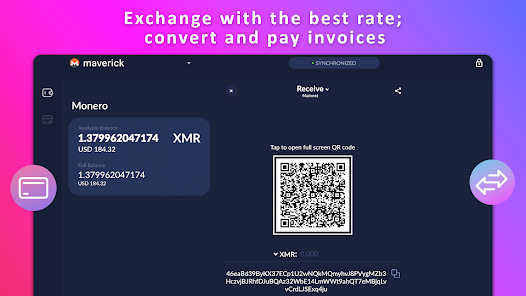
Cake Wallet is an example of the multi-currency privacy wallet archetype. It integrates Monero features (background sync, subaddresses, private view key stays on device), Bitcoin privacy tools (Silent Payments, PayJoin v2, UTXO control), Litecoin’s optional MWEB privacy layer, and built-in swaps that use a decentralized routing mechanism akin to NEAR Intents to find competitive rates without centralized custody. It also enforces Zcash mandatory shielding to avoid transparent leaks, supports Tor-only and I2P proxies for network anonymity, and offers hardware integrations including Ledger and an air-gapped Cupcake device. That design illustrates the practical strengths and limits of the balanced approach.
Put differently: Cake Wallet aligns with Option B while providing some Option C properties (hardware integration) and strong Monero-native protections. The wallet’s zero-telemetry policy and open-source, non-custodial model reduce surveillance risk and central points of failure. But those protections only work if you use them correctly: routing through Tor, choosing appropriate nodes, and securing your device pin/biometrics are decisions the user still must make.
Trade-offs and limitations you should not gloss over
1) Migration friction: Not all ecosystems are compatible. For example, Zcash migration has a documented limitation: Zashi seed phrases aren’t compatible with Cake’s ZEC wallet because of differing change address handling. That forces manual transfers rather than seamless seed import. When moving funds across ecosystems, expect friction and follow the documented migration steps; assumptions of plug-and-play compatibility are the fastest path to lost funds.
2) Complexity vs. surface area: Multi-currency wallets expose more attack vectors. Supporting swaps, multiple chains, and decentralized routing increases code complexity. Even with open-source code and device-level encryption, the more features a wallet has, the greater the chance of an implementation flaw. Users with high security needs should consider splitting holdings: everyday privacy reserves in the mobile app, long-term cold storage on dedicated hardware.
3) Network anonymity is fragile: Tor/I2P modes and custom node connections greatly reduce IP linking, but they are not magic. Misconfiguration (leaking DNS, using cleartext network apps on the same device, or syncing public logs) can still associate activity. Assume network privacy is probabilistic, not binary.
Decision heuristics — one practical rule-set to choose what fits you
– If you mainly move Monero and value simplicity: prioritize a Monero-centric wallet or ensure your multi-currency wallet runs a local Monero node; keep private view keys on-device and use subaddresses.
– If you need one app to manage XMR, BTC, LTC, and occasional swaps: use a vetted multi-currency wallet with Tor/I2P support, decentralized swap routing, and zero-telemetry policy; accept some extra operational risk and mitigate by limiting on-device balances.
– If you hold high-value amounts or run services: favor hardware-backed, air-gapped key custody and split operational funds from savings. Use the mobile app only for small, routine amounts and always verify swap routes and addresses on an air-gapped device.
Practical checklist before you trust any privacy wallet
– Confirm the wallet is non-custodial and open-source. That gives you code transparency and control over keys.
– Verify network privacy options (Tor-only, I2P, custom nodes) and test them. Running your own node for Monero or Bitcoin is the strongest option if feasible.
– Use device-level security: Secure Enclave on iOS, TPM on Android. Combine PIN and biometrics, and avoid backups that leak private view keys unless encrypted off-device.
– For cross-chain swaps, prefer decentralized routing that aggregates market makers to avoid a single counterparty; but double-check rate slippage and time-to-finality for large amounts.
For readers ready to explore a balanced, privacy-first multi-currency wallet that implements many of these mechanisms and trade-offs, see this project page: https://cake-wallet-web.at/
What to watch next — conditional signals, not predictions
– Adoption of MWEB-like optional privacy layers (e.g., Litecoin’s MWEB) will matter because optional privacy creates a user-choice dynamic: the network’s privacy utility depends on adoption rates and UX simplicity.
– Regulatory attention in the U.S. to privacy-enhancing tech is an open question. If enforcement or compliance pressures increase, expect wallets to adjust UX (e.g., optional telemetry for “compliance modes”) or exchanges to impose stricter KYC that affects on-ramps off-chain. Monitor developer communications and privacy policy updates.
FAQ
Q: Is Monero always private if I use a privacy wallet?
A: Monero’s protocol provides strong privacy by default, but practical privacy depends on the whole stack. Network leaks (IP addresses), device compromise, or poorly handled view keys can undermine privacy. Use Tor/I2P, keep private keys off third-party servers, and consider hardware signing for higher assurance.
Q: Can I swap Bitcoin to Monero privately inside a multi-currency wallet?
A: Yes—built-in swaps and decentralized routing can reduce custody risk and improve rates. However, cross-chain swaps inherently touch both chains’ metadata. Decentralized routing (like NEAR Intents-style systems) reduces centralized exposure, but you should expect some linkability at endpoints unless you combine chain-level privacy actions and network anonymization.
Q: Should I run my own node?
A: Running your own Monero or Bitcoin node is the strongest way to remove third-party metadata exposure, but it increases technical complexity and resource use. For many U.S. users, connecting to a trusted remote node via Tor is a good compromise; for high-value custody, run a node and pair it with hardware signing.
Q: Does zero-telemetry guarantee privacy?
A: Zero-telemetry reduces the risk of data collection by developers, but it doesn’t eliminate privacy risk from network observers, exchanges, or device compromise. It’s a necessary but not sufficient condition for end-to-end privacy.
Leave a Reply